

For years, the conversation around sustainable events has been stuck at a single question: what was the footprint? Useful, but backward-looking. It tells you what already happened. It rarely changes the decision you are about to make.
That is the gap the Impact: suite was built to close – and it is why we have now aligned all three Impact: products with the United Nations Sustainable Development Goals.
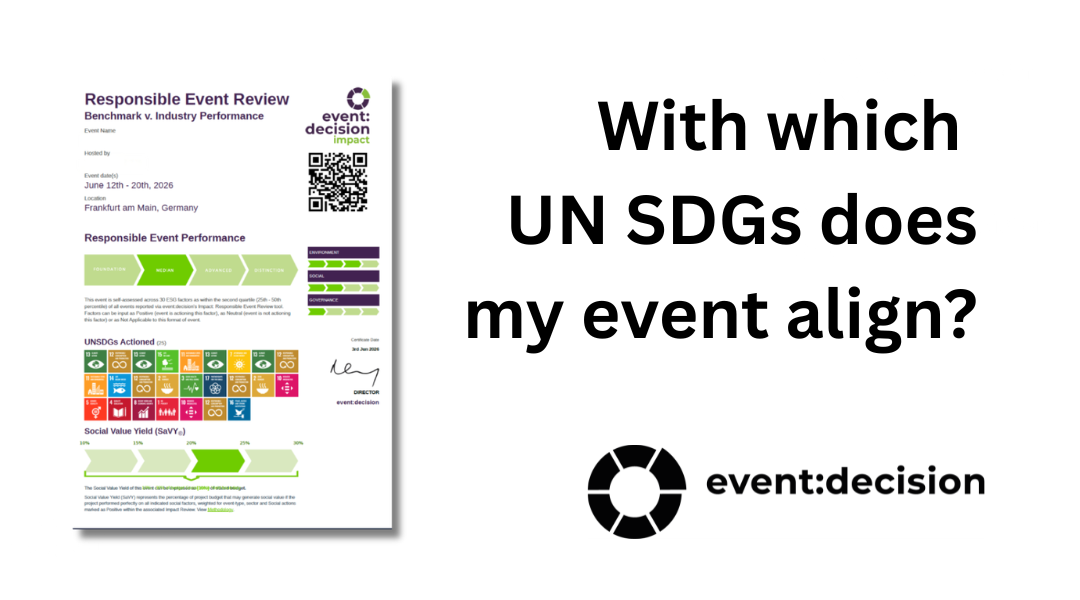
Not as a badge on the cover of a report, but as something built into the review itself and shown back to you per event. Every question you are scored against now carries an SDG. So when the results come in, you do not just see how you performed – you see which of the world’s seventeen agreed goals each of your choices advanced, and where the gaps are.
Alignment that lives inside the tool, not alongside it
The important phrase is built in. SDG alignment is not a separate exercise you run after the event, or a mapping a consultant bolts on at the end. It sits inside the question set, across the whole Impact: suite – the organiser-level review in Impact: Event, the technical production review in Impact: AdVantage, and the venue review in Impact: VenueLens.
All review questions now carry an SDG assignment: each one has a primary goal it most directly serves, plus the secondary goals that are materially relevant. Those questions span all three ESG pillars – environmental, social and governance – and between them they touch the full set of seventeen goals.
This matters because sustainability in events has never been only about carbon. A question about supplier conditions speaks to decent work. A question about accessibility speaks to reduced inequalities. A question about how decisions are documented and governed speaks to strong institutions. The SDGs already hold all of that in one framework; aligning to them lets a single review tell the whole story rather than just the climate chapter of it.
Unsurprisingly, some goals come up more than others. Responsible Consumption and Production (SDG 12) is the most frequently touched across Impact – it is the goal most events move most often, through what they buy, build, ship and throw away. Climate Action (SDG 13), Decent Work and Economic Growth (SDG 8) and the governance goals around transparent, accountable practice are close behind. But the breadth is the point: an Impact: review now reads an event against the goals it genuinely affects, not a token two or three.
Shown per event, where the decision is
Because the alignment lives in the questions, it surfaces automatically at the level that matters – the individual event. Each review now displays how that specific programme contributes to the SDGs: which goals its choices advance, which it touches only lightly, and where a “no” reveals a gap worth closing before the next one.
That changes what the output is for. A footprint number tells you how you did. An SDG view tells you what to do next – and it does so in language your clients, your board and increasingly your delegates already use to judge whether an event was worth its impact. For an organiser comparing two concepts, a production team responding to a brief, or a venue being assessed, the question stops being “is this lower-carbon?” and becomes the sharper “what does this choice actually contribute, and to which goals?”
Three vantage points, one shared language
The three Impact: products look at an event from three different seats – the organiser planning the whole programme, the technical production partner specifying power, kit, freight and crew, and the venue or M&E hotel hosting it all. Each sees impacts the others cannot.
What the SDG alignment adds is a shared language across those seats. When an organiser’s review, a supplier’s review and a venue’s review all speak in the same seventeen goals, they stop being three separate sustainability initiatives and become one aligned effort, measured the same way and visible to each other. An organiser reducing freight, a production partner switching to cleaner power and a venue cutting food waste are no longer doing three unrelated things – they are advancing the same goals, and the suite shows it.
What this changes in practice
Nothing about the rigour of an Impact: review changes – the data discipline, benchmarking and gap analysis are exactly as they were. What changes is the lens the results are shown through. Findings now arrive pre-translated into the framework the wider world already uses, and they arrive per event, at the moment decisions are still live.
Sustainability in events was never really a reporting problem. It was a decision problem. Aligning the Impact: suite to the UN SDGs – inside every question, displayed on every event – is how we make the goals part of the decision, while the decision is still yours to make.
Want to see how your next event scores against the SDGs? Contact hello@eventdecision.com