

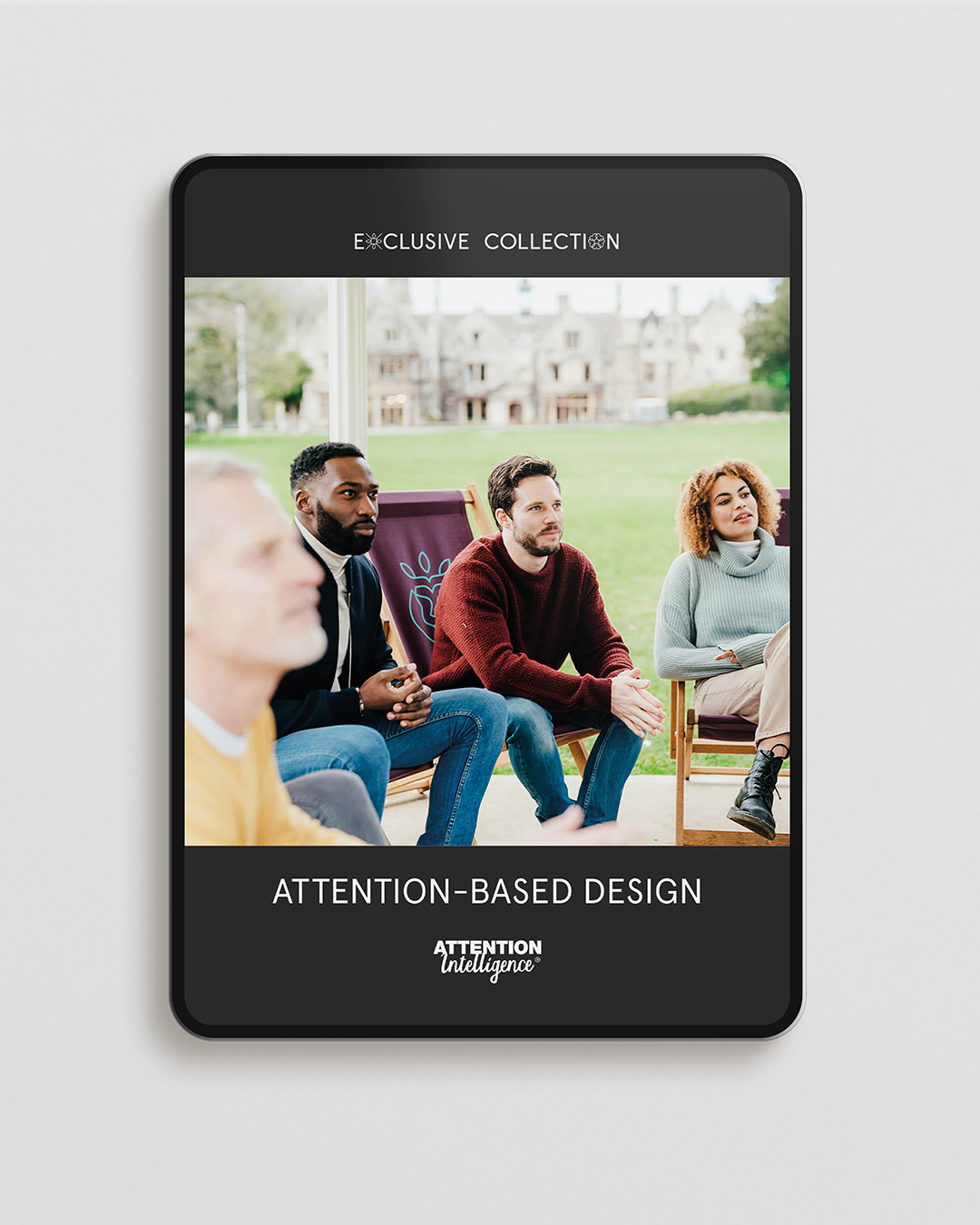
Exclusive Collection has launched its latest insight paper, Attention‑Based Design, at IMEX Frankfurt. The paperredefines how meetings, conferences and events should be planned in an era of constant distraction.
The paper, developed in collaboration with technology and productivity expert Alexander Bell, highlights a fundamental shift in how people engage at work and events: attention is no longer guaranteed, it must be earned. With digital behaviours such as second‑screening, notifications and constant messaging now part of everyday working life, traditional event formats are struggling to maintain focus and deliver meaningful outcomes.
Drawing on research with senior corporate event organisers, the paper reveals the scale of the challenge. The average employee now attends 13.6 meetings per week, with nearly a quarter of the working week spent in meetings, yet 35% are considered unproductive.
The findings highlight that distraction is no longer an occasional issue, but the default state. Attention-Based Design research shows that in a meeting of 100 people, as many as 84 attendees are likely to be distracted at any given time.
Stephanie Hall, Group Director of Sales and Marketing at Exclusive Collection, comments: “For years, we’ve assumed that if people are in the room, they are engaged. Today, that assumption no longer holds true. Attention‑Based Design recognises that attention is now fragile, limited and constantly under pressure. The opportunity for our industry is to design experiences that help people focus, think and connect in ways they can’t elsewhere.”
The paper outlines a new framework for event design, built around intentional attention journeys, where engagement is actively managed rather than assumed.
The research also highlights a growing economic impact, with unproductive meetings contributing to significant inefficiencies, while distraction can lead to slower decision‑making, reduced retention and missed opportunities.
The paper combines behavioural science with practical event design principles and introduces actionable approaches for planners, including:
- Designing clear, outcome‑driven (SMART) meetings
- Structuring agendas with frequent shifts every 2–5 minutes to maintain engagement
- Creating multi‑sensory, participative experiences
- Rethinking spaces to support different modes of focus, from decision‑making to creativity
Alexander Bell adds: “In a world of constant notifications and competing demands, attention has become the most valuable resource in the room. The events that succeed will be those that create the conditions for people to truly thrive – to think clearly, contribute fully and connect meaningfully with others.”
Attention‑Based Design positions events not as content delivery platforms, but as environments for shared focus, human connection and better thinking.